Test the hardness.
Scale, spots, and soap residue can be clues. A hardness test helps confirm whether softening addresses the problem you want to solve.
REAL PLUMBERS. HONEST PRICING.
Less mineral buildup. A system that fits your household. We test the water, review how your home uses it, and explain your options without a high-pressure sales pitch. Serving Jacksonville, the Beaches, and nearby communities.
WHAT WE LOOK AT
Scale, spots, and soap residue can be clues. A hardness test helps confirm whether softening addresses the problem you want to solve.
Your water use, household size, bathrooms, and fixtures help us select equipment that can handle daily demand and busy mornings.
We discuss salt, regeneration, maintenance, installation space, and service access so you know what ownership involves.
UNDERSTAND YOUR WATER
Hard water contains dissolved calcium and magnesium. It can leave scale on fixtures and water-heating equipment, spots on glass, and soap residue. A conventional ion-exchange softener reduces these hardness minerals. It won’t solve every water concern.
Local hardness varies by supply and neighborhood. JEA’s hardness guide is a useful starting point, but your home’s test results matter. Hardness alone doesn’t mean the water is unsafe, and every home doesn’t need the same equipment.
We test incoming water before it passes through treatment. A hardness test measures the concentration of hardness minerals; a drop-count kit uses a measured water sample and a color change to determine the result. With an existing softener, testing before and after the unit helps us evaluate performance.
Hardness is often reported in grains per gallon (GPG). If the result is in milligrams per liter as calcium carbonate, dividing by about 17.1 gives GPG. Pentair explains hardness testing and units. A total dissolved solids meter measures something different; its reading alone doesn’t establish hardness.
Bathroom count helps us understand potential demand, but we also ask how many people live in the home, how much water you use, and which fixtures run together. Laundry, guests, and high-flow showers can change the picture.
Capacity is how much hardness a softener can handle between regeneration cycles. For example, 15 GPG multiplied by 250 gallons of treated water per day creates a daily load of about 3,750 grains. This is an illustration—not a size recommendation for every household. Water bills can help estimate use, with irrigation or other untreated water accounted for separately.
Flow is measured in gallons per minute (GPM). Two 2-GPM showers need 4 GPM together, before another faucet or appliance starts. We consider the actual fixtures and the selected system’s service-flow rating, along with usable capacity, salt settings, reserve, and regeneration frequency. Manufacturer sizing guidance considers both capacity and flow.
Softening targets hardness. Carbon filtration can address chlorine-related taste and odor when the equipment is designed for that purpose. If chloramine is the concern, the system must be rated for chloramine reduction. Check specific performance claims; a carbon filter doesn’t soften water or remove everything. NSF’s reduction-claims guide can help you compare products.
Depending on your water and priorities, we may discuss a softener, carbon filtration, a combined setup, or a different approach. Other water-quality concerns may need additional testing.
Before installation, we review the water supply, pressure and flow requirements, equipment space, drain connection, bypass, and service access. We explain what the proposed work includes and any installation changes that affect the price.
Conventional softeners need regeneration and a supply of the salt or regenerant specified for the model. Settings affect water and salt use; compare ongoing needs as well as the purchase price. EPA’s softener guidance explains why efficiency matters. Carbon media has its own service or replacement schedule.
If an existing unit is leaking, leaving hardness behind, or behaving differently, tell us its model and service history. We can evaluate the issue before recommending replacement. Our team keeps learning about the equipment we install so we can explain the recommendation clearly and let you decide.
SYSTEMS WE TRUST AND INSTALL
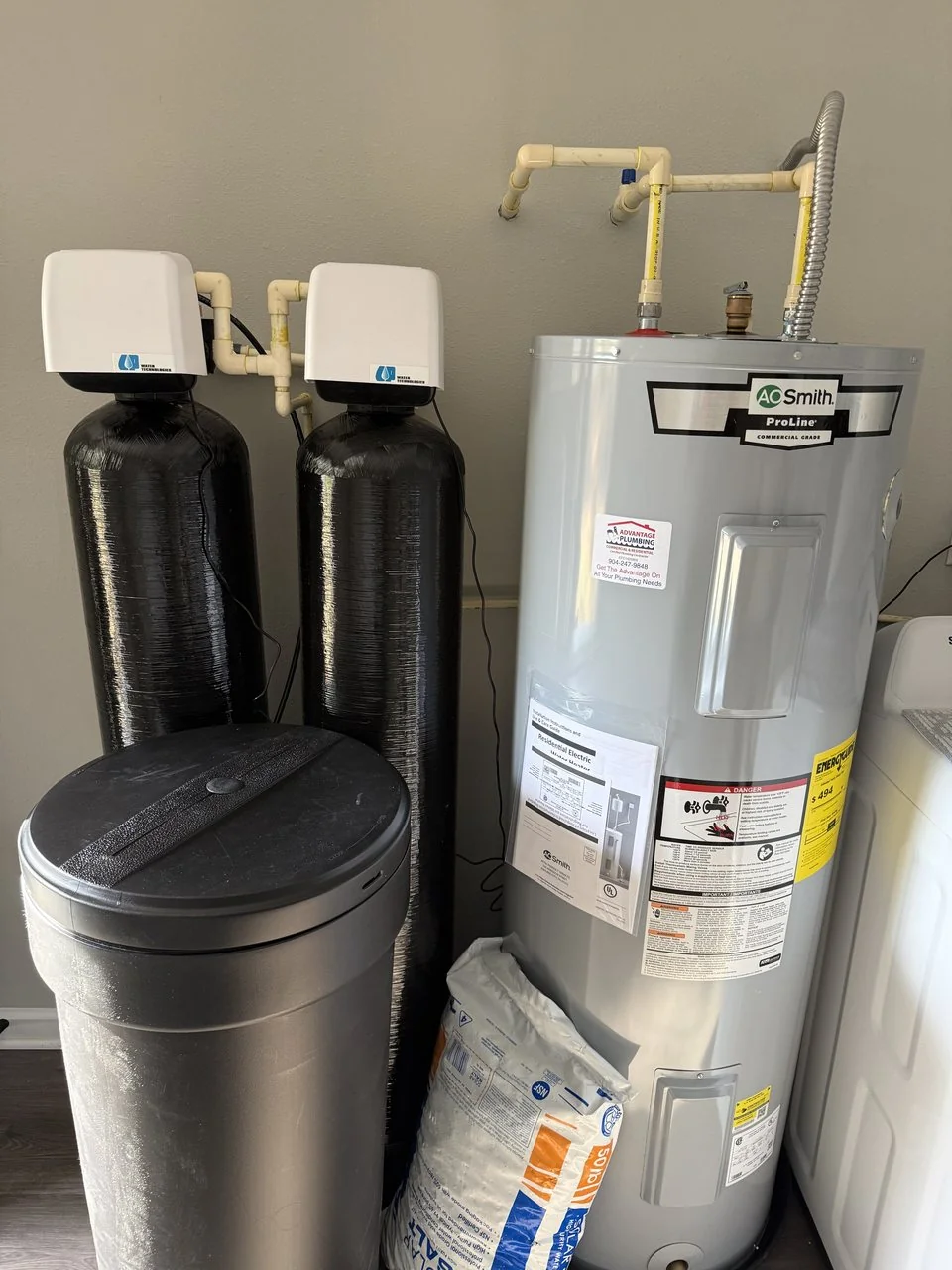
Explore the RF Series brochure for the water softeners and filtration systems we trust and install. We’ll help match the equipment to your water conditions, household needs, and available space.
View the softener & filter brochure ↗PDF · 4 MB · Opens in a new tab
HOW WE WORK
Share the symptoms, address, and any photos or prior estimates. We give pricing information over the phone whenever we reasonably can.
We explain what we find, the proposed work, and any access or scope questions. You have room to ask questions and compare options.
We recommend the work the property needs. If something changes during the job, the scope and your options belong in the conversation.
A FEW GOOD QUESTIONS
No. Actual hardness, the problems you want to improve, household demand, and your willingness to maintain the equipment guide the decision. We test and explain the findings before recommending a system.
Start with measured hardness in grains per gallon and daily treated water use. Then consider usable capacity, salt settings, reserve, regeneration frequency, and service-flow requirements. Household size and bathroom count are useful inputs, but neither alone determines the right system.
No. A conventional softener reduces hardness minerals. Carbon filtration targets specific concerns such as chlorine-related taste and odor when designed for them. Equipment for chloramine reduction must be rated for that purpose.
Yes. Share its model, age, service history, and symptoms. Testing untreated and treated water, along with checking operation, helps us understand whether service or replacement makes sense.
Follow the selected model’s instructions for salt or regenerant, settings, cleaning, and service. We explain maintenance and operating needs before installation; a separate carbon filter may also need media replacement.
RELATED SERVICES
Taste, sediment, and hardness are different concerns. We help you match the treatment approach to your water source, your priorities, and the actual system requirements.
Explore Water TreatmentLooking to address taste, sediment, or a specific water concern? We help evaluate filter options and installation needs without promising that one product removes everything.
Explore Water FiltrationTankless can be a useful choice, but it isn’t a simple swap for every home. We evaluate demand, equipment requirements, and installation changes before recommending it.
Explore Tankless Water Heaters